
May 7, 2026
Understanding Utility-Scale Solar Design and Installation
Utility-scale solar facilities require detailed planning and construction. Here’s an overview of how they are designed and built.
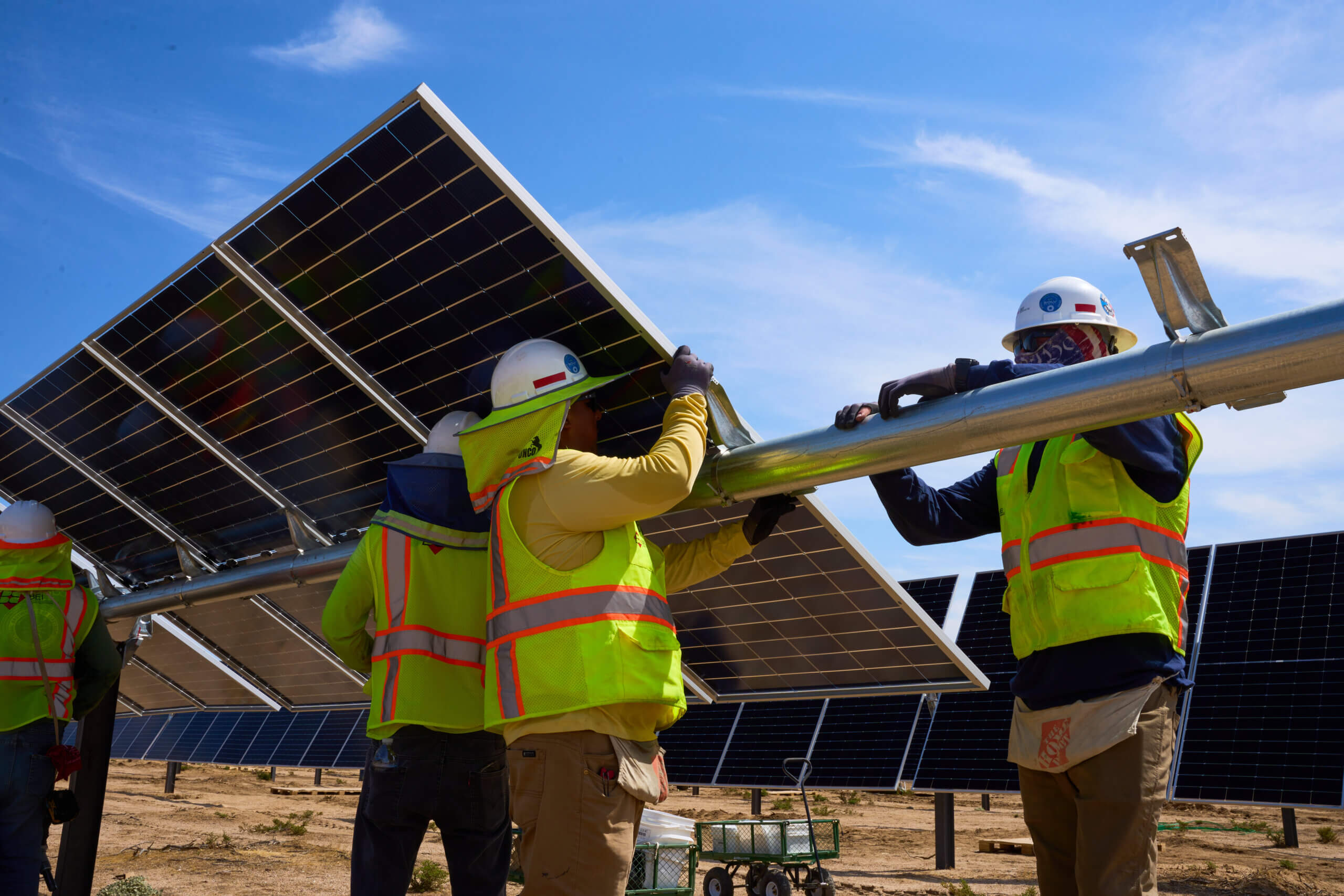
Solar power generation is increasing rapidly as it has become the most cost-effective energy source driven by growing investments in utility-scale solar projects across the U.S. Utility-scale solar projects are electricity generating facilities with ground mounted photovoltaic (PV) panels capable of powering tens of thousands of homes annually, with no harmful emissions. Today, these solar facilities generate enough electricity to power 33 million homes nationwide. Utility-scale solar accounted for 54% of all new generation capacity added to the U.S. grid in 2025, helping meet rising demand.
To continue bolstering the grid and leveraging the many benefits of solar energy, the U.S. needs more utility-scale solar projects in communities across the country. What does installing these facilities entail?
Utility-Scale Solar Design and Installation
Utility-scale solar design and installation involve the following steps:
- Assessment and planning
- Design and optimization
- Site preparation
- Installation
- Commissioning and operations
Step 1: Assessment and Planning — Laying the Groundwork
The assessment and planning phase of a utility-scale solar project can take five to 10 years and involves careful coordination across land, community, permitting, and financing.
Projects begin with site selection, identifying open land with strong sun exposure, suitable soil conditions, and access to existing transmission infrastructure.
At the same time, developers work closely with landowners, local officials, permitting agencies, and community members to shape a project that fits the area and addresses local priorities.
Environmental and cultural studies are conducted to protect natural resources and respect local history, while permitting ensures compliance with all federal, state, and local requirements.
Equally important, projects must secure financing and long-term commercial offtake agreements. These agreements with utilities or corporate buyers provide a stable revenue stream, making it possible to raise the capital needed to build the project.
Together, these steps lay the foundation for a project that can move forward with confidence, with the technical, financial, and community support needed to get built.
Step 2: Design and Optimization — Built for Performance and Safety
Once the site is secured, the focus shifts to designing a project that performs reliably for decades.
This includes selecting solar panels, inverters, and mounting systems, as well as determining layout details like spacing, tilt, and orientation to maximize energy production.
Most utility-scale projects today use tracking systems that allow panels to follow the sun throughout the day, increasing output while also helping protect equipment during severe weather by adjusting panel angles when needed.
Safety and durability are built into every decision. Panels are constructed with multiple sealed layers, including tempered glass similar to what’s used in car windshields, and are tested to ensure they do not pose risks to people or the environment.
At this stage, developers are also making decisions about land use. Projects are designed to minimize disturbance, with infrastructure occupying only a small portion of the site while the majority of the land, where it fits the land, remains available for vegetation, habitat, or co-located agricultural use.
Step 3: Site Preparation — Setting the Stage
Before construction begins, the site is carefully prepared to ensure long-term stability and responsible land use.
This work includes clearing and grading only where needed, installing erosion and stormwater controls, and building interior access roads so crews can safely move equipment across the site.
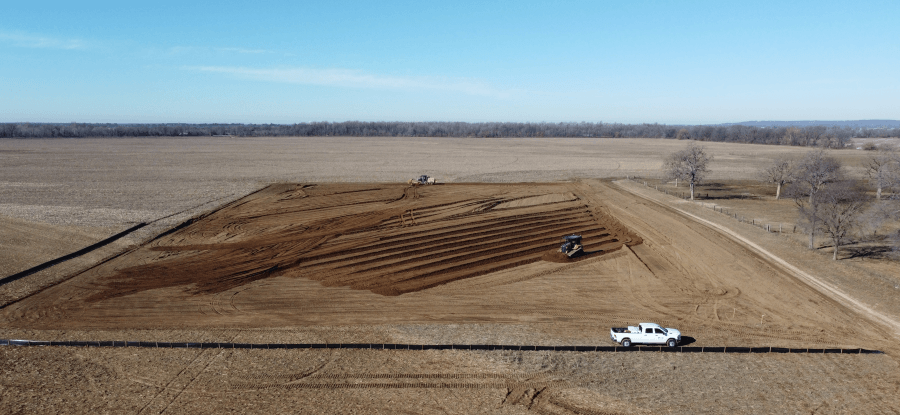
Vegetation planning is a key part of this phase. In many cases, sites are pre-seeded before construction even starts. This helps stabilize soil, manage stormwater, and establish native groundcover that supports long-term soil health and local ecosystems.
Fencing is also installed to secure the site and protect public safety, with designs that can blend into the surrounding landscape and, where appropriate, accommodate wildlife movement and agricultural uses like sheep grazing.
By the time this phase is complete, the site is ready for construction while still preserving the land for future use.
Step 4: Installation — From the Ground Up
With the groundwork in place, construction moves quickly. Most utility-scale solar projects are built in only 12 to 18 months.
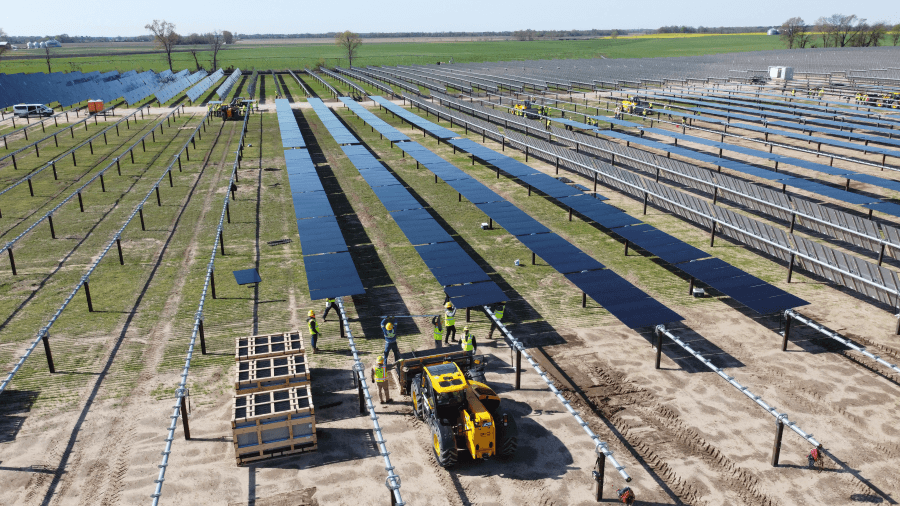
The process starts with installing steel piles, which are driven directly into the ground to form the foundation for the project. These piles require no concrete and typically cover less than 5% of the total land area, making future land restoration straightforward.
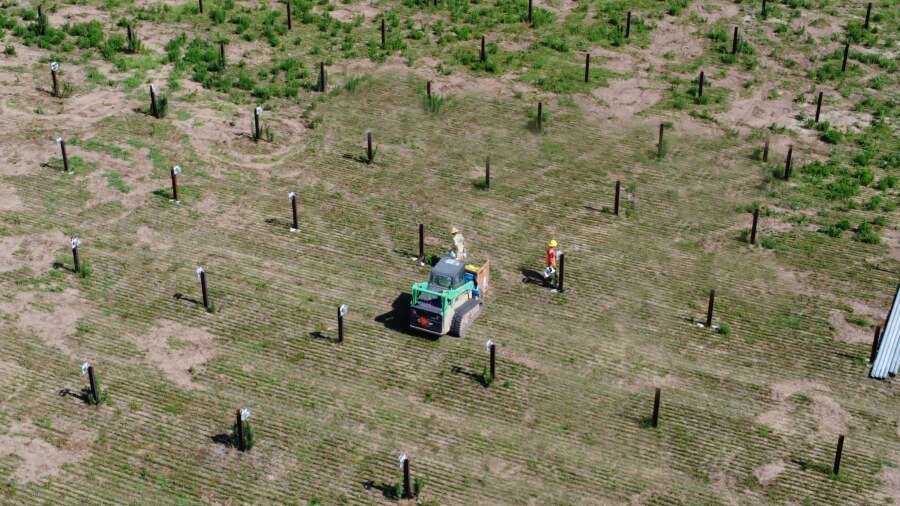
Racking systems are then mounted on the piles, followed by the installation of solar panels. Panels are arranged in rows and connected in “strings” to create the right voltage for efficient power flow.
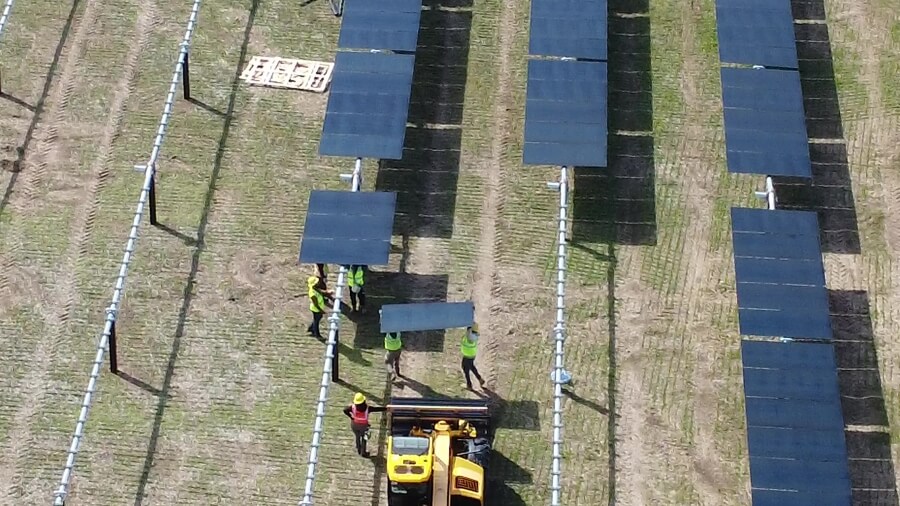
Next comes the electrical infrastructure. Inverters convert the electricity generated by the panels from direct current to alternating current, which can be used on the grid. Transformers then step up the voltage so it can be transmitted efficiently.
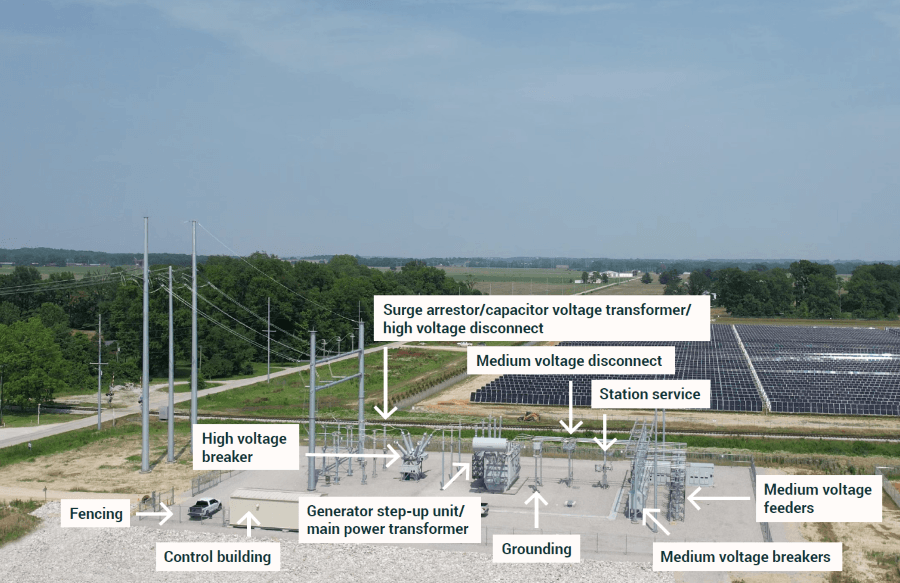
All of this connects to a project substation, which serves as the link between the solar facility and the broader electric grid, ensuring the power meets grid requirements and is delivered safely and reliably.
Throughout construction, teams work to minimize noise, dust, and disruption, keeping the impact on nearby communities as low as possible.
Step 5: Commissioning and Operations — Ready to Deliver Power
Once construction is complete, the project goes through a detailed commissioning process before it begins operating.
This includes inspecting all equipment, testing electrical and mechanical systems, verifying performance, and ensuring the project meets all utility and regulatory requirements.
Only after passing these checks is the project energized and connected to the grid.
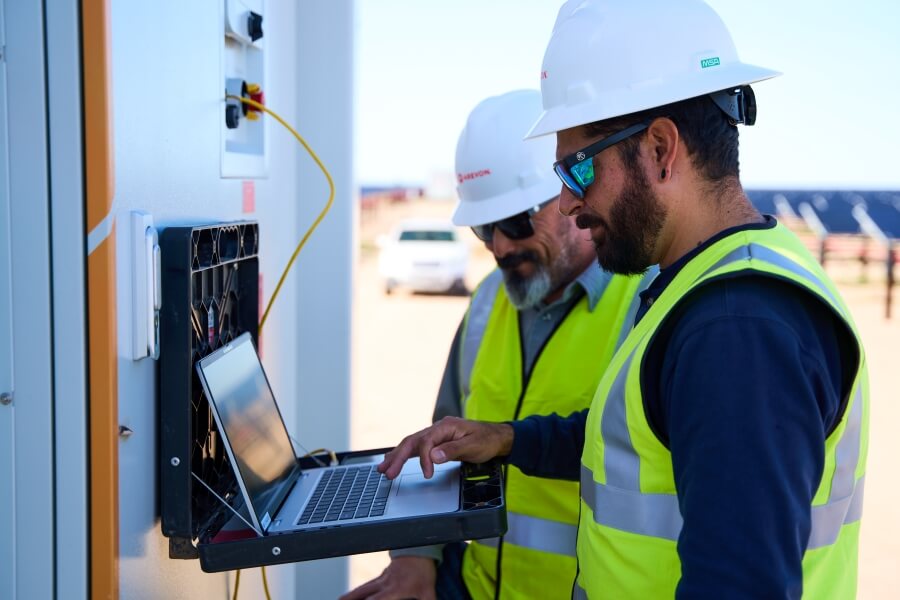
From there, operations teams monitor the facility around the clock. Advanced systems track performance in real time, allowing operators to quickly detect and address any issues and respond to changing conditions, including severe weather.
With proper maintenance, these facilities provide reliable power for 30 years or more, delivering consistent energy while remaining a responsible part of the surrounding community.
Partner With Arevon for Utility-Scale Solar Project Development
With proper planning and execution, utility-scale solar projects create a reliable, low-cost supply of American energy for decades. Arevon is a U.S. energy leader with solar, energy storage, and solar-plus-storage projects across the country. Our community-first approach and long-term project ownership ensures maximum social and environmental benefits. Contact us today to start planning your utility-scale solar project.
This is Arevon
Follow us on LinkedIn for more stories of how we’re powering progress.
Do You Have Questions About Utility-Scale Solar Construction? Explore Our FAQs
Back to Insights